






ACM20121 Certificate II in Animal Care (VETDSS High School)

Study Animal Care as part of your High School Program – choose from our Flexible Online Option or Face-to-Face Training at Landsdale Farm in WA

Nationally recognised training in animal care

Online

Face-to-face

Study Animal Care while still at School

AVT’s ACM20121 Certificate II in Animal Care is a Vocational Education and Training Delivered to Secondary Schools (VETDSS) program designed for Years 10–12 high school students who want to combine their final years of school with practical training in the animal care industry. This course is accessible to students across Australia, with three study options depending on their location and personal situation.

Find your program:

Online

Full-fee: From school or at home
$2,845
  • Years 10-12 high-school aged students
  • Anywhere in Australia^
  • You find an animal care workplace near you
  • Suitable for at-school or home-schooled students
  • Self motivated to study online

Online

Funded: Online
$0*
  • Years 10-12 attending high school
  • Live in WA
  • You find an animal care workplace near you
  • Support of your school VET Co-ordinator
  • Self motivated to study online
Funded

Landsdale Farm

Funded: Face-to-Face
$0*
  • Years 10-12 attending high school
  • Live in Perth
  • Attend Landsdale Farm 1 day a week (no placement needed)
  • Support of your school VET Co-ordinator
  • Best for students who like in-person learning
Funded

Students who complete this certificate can progress into veterinary nursing training or begin entry-level roles in animal care.

*See full funding details and conditions below  |  ^Students require access to a work placement

VET program with funding for school students

Course outline

Choose your preferred study mode

Choose your preferred study mode

Online Students

This is a flexible online course option where you are not required to attend classes. As a student, you will:

  • Have up to 12 months to complete, or sooner if work placement requirements are met (see next section).
  • Be provided with a login to our Online Learning Platform where you will find all of the course materials including interactive learning material, videos, and assessments.
  • Receive assistance from our qualified Trainers and Assessors whenever needed.
  • Have help from our student support team to help you stay on track.
  • Be assessed in various methods including:
    • Online multiple-choice quizzes and tests
    • Written and practical assignments
    • Oral testing via phone
    • Video and photographic submissions

To successfully complete this course, you’ll need to undertake a work placement as part of your practical training. The following applies:

  • We recommend 100 hours of workplace-based training. Actual hours required may vary, depending on your previous experience, learning style and aptitude.
  • You are responsible for finding and securing your own work placement. 
  • You can choose a workplace that suits your location, availability and interests (workplaces must be approved by AVT).
  • Your placement must provide access to at least two different animal species and animals at different life stages.

Suitable workplaces may include kennels, catteries, doggy day care centres, animal welfare shelters, pet shops (with access to animals), wildlife rehabilitation centres, zoos or veterinary practices. 

For more information, see our Work Placement FAQ’s below or visit Practical Work Placements in Animal Care.

There are no prerequisites for entry into this course, however students must:

  • Be of high school age and if seeking a WA Funded position, be attending a WA high school
  • Provide their unique student identifier (USI)
  • Complete a language, literacy, numeracy and digital skills (LLND) quiz
  • Have a reliable internet connection and access to a computer or laptop. You will be required to write, submit and in some cases upload assessments and various types of multi-media files
  • Be proficient in speaking and writing in English
  • Be physically capable of restraining animals, handling animal feed e.g. large bags of food of up to 10kg and standing for extended periods of time
  • Find a suitable workplace that provides access to at least two animal species and animals at different life stages

The following information outlines what you can expect during this course. We care about our students and their success, so if you have any concerns about the points below, we encourage you to contact our Student Support team to discuss them. 

Essential requirements
Throughout this course, you will need to:

  • Collaborate in a workplace setting using both verbal and non-verbal communication.
  • Effectively communicate with your Trainers and Assessors via email, phone and online learning platforms and respond promptly.
  • Follow written and verbal instructions accurately, both within online coursework and from supervisors during your work placement.
  • Demonstrate digital literacy skills to navigate the online learning portal, access resources and upload assessment evidence.
  • Complete workplace documentation using industry-specific language relevant to your host facility.
  • Wear Personal Protective Equipment (PPE), as required by your workplace, including enclosed shoes, gloves and sun protection.
  • Secure and participate in a suitable work placement in an animal care facility, handling and caring for various species. This environment, by its nature, will expose you to potential allergens.
  • Adhere to hygiene protocols to ensure animal health, which may involve contact with animal waste such as uneaten food, urine, faeces, soiled bedding and enrichment items.

Environmental requirements
In this course, you will:

  • Manage your own learning schedule and progress through online theory content, requiring self-motivation and effective time management.
  • Adapt to the operational environment of your host facility, which may require working outdoors and being exposed to various weather conditions.
  • Function in a busy workplace environment which may include noise (such as barking), strong odours, and physical activity.
  • Interact with workplace staff and the general public, maintaining professional conduct at all times.
  • Be physically capable of the manual handling requirements of your workplace, including lifting equipment, bending and standing or walking for extended periods.

Psychosocial requirements
Given the nature of work in the animal care and welfare environments, and the delivery of training within a third-party workplace, you will need to:

  • Manage exposure to diverse animal behaviours, including animals that may be excited, stressed, fearful, unwell or difficult to handle.
  • Cope with the realities of animal care in your chosen workplace; this may include managing animal hygiene and grooming needs, witnessing illness or injury.
  • Maintain appropriate emotional regulation and professional behaviour in busy and sometimes unpredictable environments.
  • Maintain an inclusive and supportive attitude by interacting respectfully with workplace colleagues and clients of all backgrounds and identities.
  • Receive and respond to feedback from your workplace supervisor and your online Assessor in a constructive manner.
  • Manage the demands of study by balancing online coursework, practical placement hours, and assessment deadlines alongside your personal or employment commitments.

Assessment types
You will be assessed on your skills and knowledge in various ways, including:

  • Written answers, online quizzes and knowledge tests.
  • Projects and logbooks completed during your work placement.
  • Video evidence of practical tasks submitted for review.
  • Third-party reports and feedback provided by your workplace supervisor.

When you visit your Work Placement you will be required to wear:

  • An AVT shirt and name badge (supplied by AVT),
  • Suitable enclosed shoes (supplied by student),
  • Neatly presented, long comfortable work pants suitable for bending and manual work (supplied by student).

You will be required to wear the AVT uniform unless specified by your approved workplace. 

Support for VET Coordinators

We work closely with VET Coordinators to help ensure students are supported, informed, and progressing throughout their course.

  • Clear delivery agreements – You can request a formal Memorandum of Understanding (MOU) outlining how we deliver to secondary students.
  • Structured student onboarding – Student agreements are reviewed and signed by VET Coordinators and parents to ensure clear expectations from the beginning.
  • Reporting  aligned with school timeframes – We provide student reports in line with your internal school schedules, including WACE or equivalent end-of-year reporting requirements. 
  • Progress visibility – Receive regular student progress updates or request reports at any time. They will also be given access to the online learning system to check student’s results and progress at anytime. 
  • Active student support – We monitor student engagement and step in early to support students who need it.
  • Ongoing communication – Our team is available to answer questions and work with you throughout the student journey.
For more detailed information, see our dedicated Schools Page

Choose your preferred study mode

Face-to-Face at Landsdale Farm

As part of this course, you will:

  • Attend Landsdale Farm in Darch, WA 1 day per week from 8:00am – 3:00pm. 
  • Work hands-on with a range of companion and farm animals at the Farm
  • Complete online learning from home and during classes

You do not have to worry about finding a work placement normally required for this course. 

Our qualified Trainers deliver supervised practical training and assessments with a structured study timetable to ensure you stay on track. All Trainers hold valid working with children checks to ensure your safety.

Students must:

  • Be available to participate in ALL training days (1 day per week) including a class commencement day in December 
  • Complete a supervised language, literacy, numeracy and digital skills (LLND) quiz at your school
  • Be physically capable of restraining animals, handling animal feed e.g. large bags of food of up to 10kg and standing for extended periods of time
  • Provide a unique student identifier (USI)
  • Bring a laptop and headphones on-site each week to complete online assessments
  • Have a reliable internet connection and access to a computer or laptop at home or school to write, submit and in some cases upload assessments and various types of multi-media in your own time 

Students with eligible credit transfers may apply; however, due to the course delivery format, 100% attendance is required for on-site training days.

You will be required to wear:

  • An AVT top, hat and name badge (supplied by AVT)
  • Steel-capped shoes (supplied by student)
  • Neatly presented, long comfortable work pants suitable for bending and manual work (supplied by student).

The following information outlines what you can expect during the course.  If you have any questions or concerns about these expectations, please contact our Student Support team.

Essential requirements
Throughout this course, you will need to:

  • Collaborate in group settings using both verbal and non-verbal communication.
  • Effectively communicate with your peers and Trainers and Assessors.
  • Follow written and verbal instructions accurately.
  • Engage in group activities and practical assessments alongside your peers.
  • Complete workplace documentation using industry-specific language.
  • Wear Personal Protective Equipment (PPE), including steel toe-capped boots, gloves and sun protection.
  • Work within an animal care facility, handling and caring for various species. This environment by its nature will expose you to potential allergens.
  • Adhere to hygiene protocols to ensure animal health, which may involve contact with animal waste such as uneaten food, urine, faeces, soiled bedding and enrichment items.

Environmental requirements
In this course, you will:

  • Attend classes with a maximum of 24 students.
  • Work outdoors, exposed to various weather conditions.
  • Encounter moderate levels of noise, including animal sounds, the general public and farm machinery.
  • Be physically capable of lifting equipment, and standing or walking for extended periods.

Psychosocial requirements
Given the nature of work in animal care and working farm environments, and the delivery of training within a third-party workplace, you will need to:

  • Work effectively and respectfully within small groups, managing differences of opinion constructively and seeking guidance when needed.
  • Communicate clearly and respectfully with peers, farm staff and Trainers to support animal welfare and maintain a safe working environment.
  • Demonstrate inclusive and respectful behaviour in a workplace operated by an NDIS approved provider, interacting appropriately with people of all backgrounds, identities and abilities.
  • Cope with the physical and sensory demands of an animal care and farm environment, including noise, odours and busy surroundings, without becoming overwhelmed.
  • Maintain appropriate emotional regulation and professional behaviour in environments where members of the public may be present.
  • Show patience and composure when working with animals that may be unpredictable or uncooperative.
  • Follow Work Health and Safety procedures consistently to minimise risk to themselves, others and the animals in their care.
  • Demonstrate reliability by attending all scheduled sessions, contributing to group tasks and completing required activities.
  • Adapt to changing conditions within a farm environment, including weather, animal behaviour and instructions from supervisors.

Possessing these skills is fundamental to succeeding in the course and building a sustainable career in the animal care industry. If you have any concerns about your ability to meet these psychosocial requirements, we encourage you to reach out to our Student Support team.

Assessment types
You will be assessed on your skills and knowledge in various ways, including:

  • Written answers, online assessments and tests, multiple choice questions, presentations, verbal questioning and practical tasks visually assessed by Trainer and Assessors.

Considering our Landsdale Farm option for 2027?

Take a look inside our face-to-face training

Where this course can lead you

AVT animal care graduates are successful in starting their careers in a variety of roles. 

Job outcomes

High School Students who complete ACM20121 Certificate II in Animal Care start out in roles such as:

Career opportunities

Some of the organisations actively recruiting Animal Care graduates include:

  • Dog, cat and pet boarding facilities
  • Shelters for animals including rehoming organisations
  • Retail businesses such as pet shops
  • Wildlife care and rehabilitation centres
  • Animal welfare organisations
  • Farming and agricultural organisations
  • Horse agistment and stables
  • Veterinary clinics

Study pathways

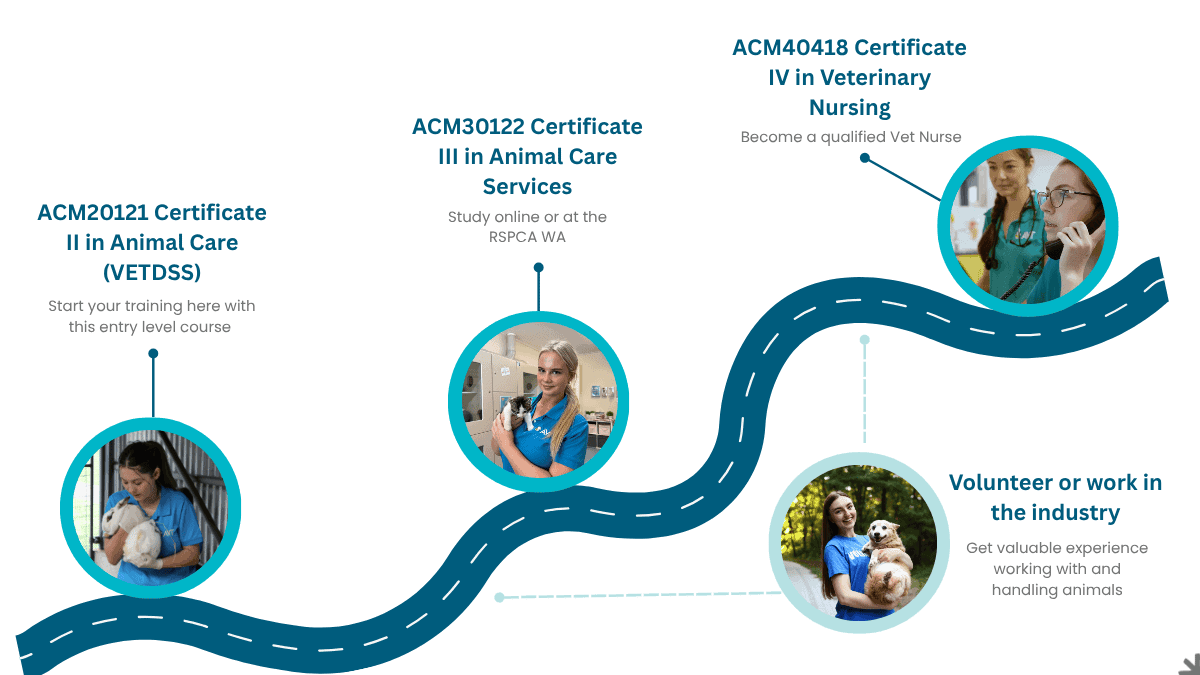
AVT Study pathway for cert II - map for animal care

Completion of this qualification meets the prerequisite for ACM40418 Certificate IV in Veterinary Nursing however, it does not guarantee you a place. Due to high demand, our AVT selection criteria also apply. Please read full details on our Veterinary Nursing Course Entry page.

What will you learn?

Whether you are studying with us face-to-face or online, you will develop the knowledge and skills to approach, handle, and care for animals. At Landsdale Farm, students apply these skills by working with farm animals in a hands-on environment, while online students apply their learning in a real workplace, with animals available to them.

In addition to the topics covered in the Certificate II in Animal Care VET schools course, you will be introduced to:

  • Working in the world of animal care
  • Understanding body language in animals and how to encourage natural animal behaviour
  • Safety around animals including how to keep you and animals safe from each other
  • Communication skills including how to build effective relationships with supervisors, peers, customers and clients
  • Sustainability in the animal care industry
  • Providing animal care information including care and welfare guidance
  • Practising low stress animal handling and minimising stress
  • Observing animal behaviour for health and wellness
  • Enrichment in an animal care environment
  • Basic animal health care including first aid for animals
Study animal care at high school

Course content

Our ACM20121 Certificate II in Animal Care VETDSS for High School Students course content is regularly updated, is easy to follow and will help you understand and apply theory.  Students will complete the following units: 

  • ACMWHS201 Participate in workplace health & safety processes
    Learn how to identify hazards, follow safety procedures, and contribute to a safe working environment for yourself, your team, and the animals in your care.
  • ACMGEN202 Complete animal care hygiene routines
    Develop the skills to maintain clean, hygienic environments, including cleaning enclosures, equipment, and following infection control procedures.
  • BSBCMM211 Apply communication skills
    Build effective communication skills to interact professionally with colleagues, supervisors, and clients in a workplace setting.
  • ACMGEN203 Feed & water animals
    Gain practical knowledge in preparing and providing food and water to animals, ensuring their nutritional needs and wellbeing are met.
  • ACMGEN204 Assist in health care of animals
    Learn how to support basic animal health care tasks, including observing signs of illness and assisting with routine treatments under supervision.
  • ACMSUS201 Participate in environmentally sustainable work practices
    Understand how to work in an environmentally responsible way by reducing waste, using resources efficiently, and following sustainable workplace practices.
  • ACMGEN201 Work in the animal care industry
    Explore what it means to work in animal care, including industry expectations, roles, responsibilities, and professional standards.
  • ACMINF201 Handle companion animals safely and follow infection control guidelines
    Develop safe animal handling techniques while applying infection control measures to protect both people and animals.
  • ACMGEN205 Source and provide information for animal care needs
    Build skills in researching and sharing accurate information to support animal care decisions and meet client or workplace needs.
  • ACMGEN102 Approach and handle a range of calm animals
    Gain confidence in approaching and handling calm animals safely, using low-stress techniques appropriate to different species.
  • ACMGEN309 Provide basic animal first aid
    Learn how to respond to common animal emergencies by providing basic first aid and seeking further veterinary assistance when needed.
  • ACMGEN311 Maintain and monitor animal health and wellbeing
    Develop the skills to assess, monitor, and support an animal’s overall health and wellbeing, including recognising changes in behaviour or condition and taking appropriate action within your role.

Why choose AVT for your VET Animal Care Course?

In partnership with your school

We work alongside your school and VET Coordinator to support your progress, answer questions, and help you stay on track.

Hands-on, industry-ready learning

You’ll build real skills in practical environments, guided by our trainers with current industry experience.

Streamlined Course Design

Our clustered course format has been designed to reduce repetition and allow you to progress quickly and complete your course sooner.

We’re invested in your success

We actively monitor your progress and step in early to support you, so you have the best chance of completing your course.

What students are saying about this course

Fees & inclusions

Funded students: $0*

Eligible Jobs and Skills WA VETDSS funded students are exempt from course and resource fees.

Non-funded students: $2,845

Non-funded students are eligible for our monthly payment plan. This includes an initial payment of $400 plus 11 x $235 monthly payments.

What you get:

Eligibility for Jobs and Skills WA VETDSS funded place

The ACM20121 Certificate II in Animal Care is included on the Department of Training and Workforce Development’s VET delivered to Secondary Schools (VETDSS) funded list.

The State Government has committed to increasing VETDSS places to ensure that more WA school students have access to high quality VET in schools as an option that contributes to them attaining their Western Australian Certificate of Education (WACE). Please see the Jobs and Skills WA Fact Sheet for VET Delivered to Secondary Students (VETDSS) for more detailed information on eligibility and criteria.

The VET Fees and Charges Policy applies to Department funded VET delivered to secondary students. This means enrolled school students are exempt from course and resource fees if they are undertaking a Department funded VET course. Read eligibility and criteria information.

Check to see if you meet the entry requirements before applying for a funded place. 

*Fees subject to change. Please visit our website or speak to our Student Support team for information on eligibility. Funded places are subject to eligibility and availability. Student tuition fees are indicative only and are subject to change given individual circumstances at enrolment.

Apply now

Study online
Non-funded Students

Study online
Funded WA Students

Study at Landsdale Farm (WA)
Next Intake 2027

Want to study face-to-face at Landsdale Farm?  If “Apply Now” is visible, applications are open, jump in early, as places are limited and fill fast. Not ready yet or planning ahead? Register your interest, and we’ll keep you updated. 

Please note, AVT may make changes to the course location or training days if required (see cancellation policy). View full details of the application process →

FAQs

International – FAQ

 If you are in Australia on another type of visa, your eligibility to study depends on the specific conditions attached to your visa. AVT is not able to enrol students in nationally recognised qualifications on a student visa.

  • Other visas – Some registered training organisations (RTOs), including AVT, may enrol non-resident students who are temporarily visiting or living in Australia on certain visas other than a student visa. See important information about Jobs & Skills WA Funding eligibility including visa eligibility.

  • Restrictions – Many visas include limits on study or training. Your study and work rights are linked to your visa type.

  • Your responsibility – You must check your individual visa conditions before applying. Further information is available from the Department of Home Affairs.

Visa information for Jobs and Skills WA Funding Jobs and Skills WA funded programs

Courses shown below are subsidised under the Jobs & Skills WA funding program. Eligibility including visa eligibility, vary by course. Please refer to the links below for details:

ACM20121 Certificate II in Animal Care – Eligibility details for each stream:

ACM30122 Certificate III in Animal Care Services (RSPCA) – Eligibility details >>

ACM40418 Certificate IV in Veterinary Nursing – Eligibility details >>

Related FAQs:


CRICOS (The Commonwealth Register of Institutions and Courses for Overseas Students) is the Australian official register of training providers approved to deliver courses to international students on a Student Visa. Any qualification undertaken by a Student Visa holder must be listed on CRICOS and delivered by a CRICOS-registered provider.

In some cases, a registered training organisation (RTO) may enrol students who are temporarily visiting or living in Australia on other types of visas (not a Student Visa). However, many visas include restrictions on study or training. It is each individual’s responsibility to check their visa conditions to confirm their study and work rights. You can verify these with the Department of Home Affairs.

Related FAQ’s:

Tags: international, overseas, visa, CRICOS

Unfortunately, we cannot assist individuals studying as international students as we do not hold the required CRICOS (The Commonwealth Register of Institutions and Courses for Overseas Students) registration.

You may find CRICOS registered training institutions in Australia that can offer qualifications to international students. Some TAFE (Technical and Further Education) institutions hold CRICOS registration and offer Animal Care and Veterinary Nursing courses.

Related FAQ’s:

Tags: international, overseas, visa, CRICOS

AVT is not able to accept international students wishing to study on-campus in Australia on a Student Visa. To enrol students on a Student Visa, training providers must be registered with CRICOS (The Commonwealth Register of Institutions and Courses for Overseas Students). AVT does not hold this registration.

If you wish to study on-campus in Australia with a Student Visa, you will need to apply through a CRICOS-registered provider. Some TAFE (Technical and Further Education) institutions are CRICOS-registered and may offer qualifications in Animal Care and Veterinary Nursing.

Related FAQ’s:

Tags: international, overseas, visa, CRICOS

AVT is not able to accept applications for online qualifications from students who reside outside of Australia.

All AVT qualifications require students to learn and demonstrate knowledge of Australian legislation, regulations and industry standards, as well as apply these in practical settings. Because these requirements differ from those in other countries, we are unable to assess and recognise competence for students living overseas.

Related FAQ’s:

Why choose AVT?

Dedicated Animal Care College

AVT has been delivering Vet Nursing and Animal Care related courses for over 25 years. It's safe to say there are no plumbing or hairdressing courses here!

Prerequisite course for veterinary nursing

Outstanding Track Record

A recent NCVER VET student outcomes report found 92% of AVT graduates were employed or enrolled in further study after training and 92% of graduates would recommend the training provided by AVT.

Prerequisite course for veterinary nursing

Safe and Supported Learning

Our qualified teaching team have many years of experience as well as extensive backgrounds in the veterinary and animal care industry. They're approachable and dedicated to helping students succeed.

Download Course Flyer

Before you get started

Answer our quick checklist to ensure your application is processed

This field is hidden when viewing the form
Course outline(Required)
USI(Required)
LLND(Required)
Parent/guardian approval
School approval
VET Co details
High school ID number
I'm prepared to:
PS(Required)

Before you get started

Answer our quick checklist to ensure your application is processed

This field is hidden when viewing the form
Course outline(Required)
USI(Required)
LLND(Required)
Parent/guardian approval
School approval
VET Co details
High school ID number
I'm prepared to:
PS(Required)

Search