
Study Animal Care as part of your High School Program – choose from our Flexible Online Option or Workplace Practical Training at Landsdale Farm in WA

Applications may close early due to high demand
AVT’s ACM20121 Certificate II in Animal Care is a Vocational Education and Training Delivered to Secondary Schools (VETDSS) program designed for Years 10–12 high school students who want to combine their final years of school with practical training in the animal care industry.
This course is accessible to students across Australia, with three study options depending on their location and personal situation.
Students who complete this certificate can progress into veterinary nursing training or begin entry-level roles in animal care.
*See full funding details and conditions below | ^Students require access to a work placement

This is a flexible online course option where you are not required to attend classes. As a student, you will:
A work placement is required to complete your practical training. Here’s what you need to know:
Suitable placements include: kennels, catteries, doggy day care centres*, animal welfare shelters, pet shops (with access to animals), equine agistments centres and studs*, zoos and conservation parks, mobile animal exhibitors, educational farms, aquatic retail specialists and veterinary practices.
*You may require an additional placement to meet the minimum species criteria.
For more information, see our Work Placement FAQ’s below or visit Practical Work Placements in Animal Care.
There are no prerequisites for entry into this course, however students will need to:
The following information outlines what you can expect during this course. We care about our students and their success, so if you have any concerns about the points below, we encourage you to contact our Student Support team to discuss them.
Essential requirements
Throughout this course, you will need to:
Environmental requirements
In this course, you will:
Psychosocial requirements
Given the nature of work in the animal care and welfare environments, and the delivery of training within a third-party workplace, you will need to:
Assessment types
You will be assessed on your skills and knowledge in various ways, including:
When you visit your Work Placement you will be required to wear:
You will be required to wear the AVT uniform unless specified by your approved workplace.
We work closely with VET Coordinators to help ensure students are supported, informed, and progressing throughout their course.
As part of this course, you will:
You do not have to worry about finding a work placement normally required for this course.
Our qualified Trainers provide support, guidance and feedback throughout the course to help you stay on track and successfully complete your qualification.
There are no prerequisites for entry into this course, however students will need to:
This course has limited places and is highly competitive. Once your application has been reviewed by our Student Support team, we’ll contact you via email to let you know the next steps. Selected applicants will be invited to attend a phone interview.
Students with eligible credit transfers may apply; however, due to the course delivery format, 100% attendance is required for on-site training days.
You will be required to wear:
The following information outlines what you can expect during the course. If you have any questions or concerns about these expectations, please contact our Student Support team.
Essential requirements
Throughout this course, you will need to:
Environmental requirements
In this course, you will:
Psychosocial requirements
Given the nature of work in animal care and working farm environments, and the delivery of training within a third-party workplace, you will need to:
Possessing these skills is fundamental to succeeding in the course and building a sustainable career in the animal care industry. If you have any concerns about your ability to meet these psychosocial requirements, we encourage you to reach out to our Student Support team.
Assessment types
You will be assessed on your skills and knowledge in various ways, including:
ACM20121 Certificate II in Animal Care can help you take your first step into the animal care industry, with opportunities across clinics, shelters, kennels, grooming businesses and more.
Support veterinary teams with animal handling, cleaning, patient care and daily clinic tasks.
Help care for animals in welfare, rescue, rehoming and rehabilitation environments.
Build practical animal handling skills useful in grooming salons, pet care and retail businesses.
Care for cats and other companion animals in boarding, welfare and animal care environments.
Work hands-on with dogs in kennels, daycare centres, boarding facilities or mobile dog services.
Assist with feeding, grooming, cleaning and day-to-day care in stable or agistment settings.
Thinking ahead? Many students use this course as a stepping stone toward further study in animal care, veterinary nursing, grooming, animal welfare or behaviour.
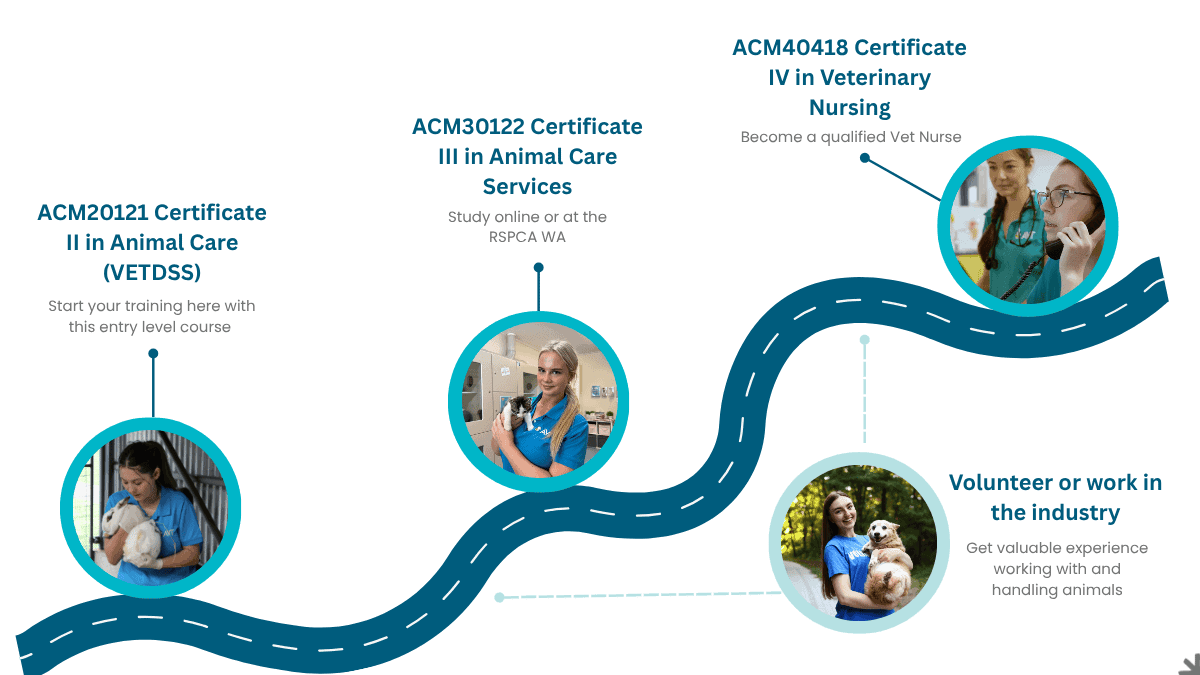
Completion of this qualification meets the prerequisite for ACM40418 Certificate IV in Veterinary Nursing however, it does not guarantee you a place. Due to high demand, our AVT selection criteria also apply. Please read full details on our Veterinary Nursing Course Entry page.
Whether you choose our Workplace Practical Training Pathway at Landsdale Farm or Flexible Online Pathway, you will develop the knowledge and skills to approach, handle and care for animals safely and confidently. Students attending Landsdale Farm build and apply these skills through hands-on training with companion and farm animals, while online students apply their learning in a real workplace environment with access to animals.
In addition to the topics covered in the Certificate II in Animal Care VET schools course, you will be introduced to:

Our ACM20121 Certificate II in Animal Care VETDSS for High School Students course content is regularly updated to reflect current industry practices. Students will complete 12 nationally recognised units of competency.
The final unit of competency varies depending on your chosen delivery mode.
Students studying the online format will complete:
Students studying the face-to-face Landsdale Farm format will complete:
We work alongside your school and VET Coordinator to support your progress, answer questions, and help you stay on track.
Spend less time sitting in a classroom at school and more time building practical animal care skills through your work placement.
Our clustered course format groups related units of competency together, reducing duplication and creating a more efficient learning experience.
Our team is committed to supporting you throughout your studies, with regular progress monitoring and guidance.


Eligible Jobs and Skills WA VETDSS funded students are exempt from course and resource fees.
Non-funded students are eligible for our monthly payment plan. This includes an initial payment of $400 plus 11 x $235 monthly payments.
Eligibility for Jobs and Skills WA VETDSS funded place
The ACM20121 Certificate II in Animal Care is included on the Department of Training and Workforce Development’s VET delivered to Secondary Schools (VETDSS) funded list.
The State Government has committed to increasing VETDSS places to ensure that more WA school students have access to high quality VET in schools as an option that contributes to them attaining their Western Australian Certificate of Education (WACE). Please see the Jobs and Skills WA Fact Sheet for VET Delivered to Secondary Students (VETDSS) for more detailed information on eligibility and criteria.
The VET Fees and Charges Policy applies to Department funded VET delivered to secondary students. This means enrolled school students are exempt from course and resource fees if they are undertaking a Department funded VET course. Read eligibility and criteria information.
Check to see if you meet the entry requirements before applying for a funded place.

*Fees subject to change. Please visit our website or speak to our Student Support team for information on eligibility. Funded places are subject to eligibility and availability. Student tuition fees are indicative only and are subject to change given individual circumstances at enrolment.
Study online
Non-funded Students
Study online
Funded WA Students
Study at Landsdale Farm (WA)
February 2027 Intake
(compulsory course commencement day in December 2026)
Study at Landsdale Farm (WA)
July 2027 Intake
Want to study face-to-face at Landsdale Farm? If “Apply Now” is visible, applications are open, jump in early, as places are limited and fill fast. Not ready yet or planning ahead? Register your interest, and we’ll keep you updated.
Please note, AVT may make changes to the course location or training days if required (see cancellation policy). View full details of the application process →
To receive a credit for a unit of competency that you have previously been awarded, you must be able to supply a verifiable Testamur (certificate) or Statement of Attainment obtained from the issuing provider.
A Testamur or Statement of Attainment must either contain the wording ‘The qualification is recognised within the Australian Qualifications Framework’ or the AQF logo authorised by the AQF Council.
A Record of Results or Statement of Academic Record by itself is not sufficient when applying for a credit transfer of a nationally recognised unit of competency.
If you do not have a copy of your Testamur or Statement of Attainment you are responsible for requesting a copy from the issuing provider, we are unable to do this on your behalf.
For more information about RPL see our frequently asked questions here.

Because we specialise in animal care, behaviour and veterinary training - everything you will learn is based on real industry needs and demands!

91% of AVT graduates are satisfied with their training experience, and 83% were employed after training (NCVER, 2025).

Students consistently tell us how supported they feel. Our trainers are here to guide you and answer your questions and help you stay on track.
Answer our quick checklist to ensure your application is processed
Answer our quick checklist to ensure your application is processed
Answer our quick checklist to ensure your application is processed